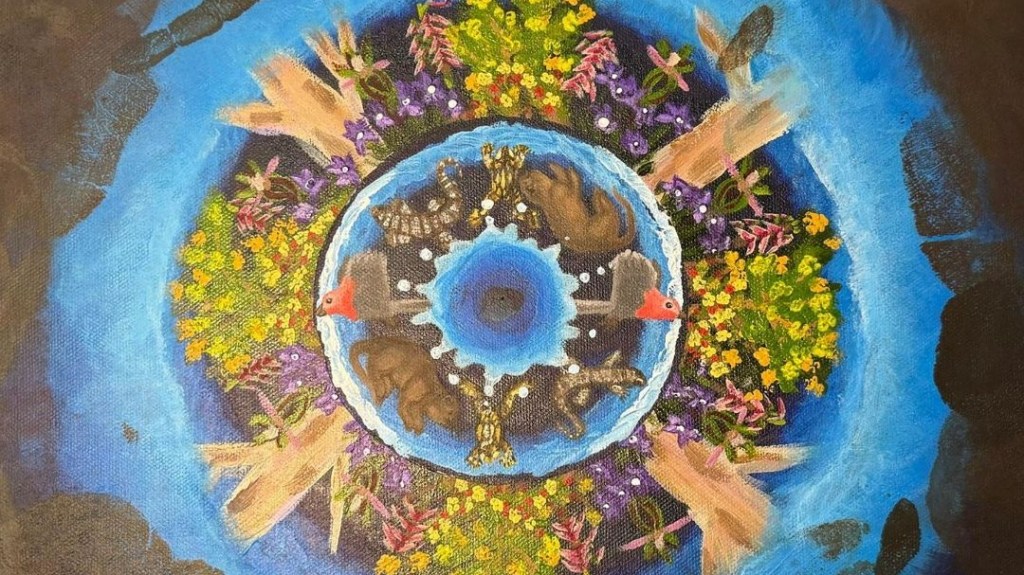
What is Decoloyarns?
Decoloyarns is an online publication featuring articles developed by any number of authors, and a circle of editors led by Indigenous cultural authority and direction.
Decoloyarns shares stories and analyses about how disciplines we love thrive in a forum where respecting Indigenous knowledges and thinking sits at the core of what researchers do. Each featured piece is a yarn (a process of conversation and storytelling to share and develop knowledge) about decolonising research – not as a theoretical and intellectual idea, but as a living practice.
Decoloyarns aim
Decolonisation means different aims and foci to different Indigenous peoples. As part of our editorial practices, each piece on this site is mentored by a First Nations cultural authority who uses discretion about how a piece addresses decolonisation. Overall, at the heart of Decoloyarns is Tuck and Yang’s 2012 work, Decolonization is not a metaphor.
This means Decoloyarns is not about talking around decolonisation to give settlers a sense of ease that non-Indigenous people can relax because “good things are happening” for Indigenous rights, in and around research and teaching. Yarns do not do decolonisation in and of themselves. You do decolonisation, reader – in partnership and relationship. Some yarns are for Indigenous readers, some are for settlers, and some hold different purposes for both.
Some yarns tell stories that fortify Indigenous insistence and demands, and share and expose real-world examples of what is possible in centring Indigenous authority, concerns, and knowledge in research and teaching, and where academic expectations and worlds are limited and need to break or be abandoned to achieve anything close to decolonisation on the terms of First Peoples on whose Country a project or institution depends.
Some yarns contain stories that act as a manual for inviting settlers to fundamentally change and push against how settlers do research, learn, and teach. Many of these yarns identify and undo settler assumptions about what is normal in the academy. These stories are about peeling back the veneer of what many of us are taught is banal, moral, ethical, and acceptable as academic practise, using ways of seeing, knowing, and doing that are offered by Indigenous people as experts. Yarns of this type are also designed to demonstrate what it looks like to fully recognise that our scholarly brains and bodies are literal property, and who occupies that property will determine how we each use our respective selves to stay focused on the intergenerational, and often distressing (given the conditions of colonisation), project of returning to live in Indigenous sovereignty.
Decoloyarns ultimately focus on processes of returning land, water, skies, scholarly authority and history to Indigenous peoples, and often specifically Aboriginal and Torres Strait Islander peoples. What does it look like, feel like, and mean to embrace an approach to learning and research that centres Indigenous concerns? How is research challenged, improved, refined, expanded, reshaped, refused, and redefined when Country and First Peoples are respected? What are our responsibilities and what can we learn from each other?
While Decoloyarns are about research, they are written for everyone – because research goes beyond the academy. Anyone can contribute, whether you’re Indigenous or non-Indigenous, scholarly or not. If you’ve got an idea for a topic for a yarn, would like to be part of a yarn, or share something you’ve learnt from a yarn, visit our Submissions page.
Our history
Decoloyarns are a project of The Fenner Decolonial Research and Teaching Circle (The Fenner Circle). It was originally a series of articles hosted by the Fenner School of Environment and Society at the Australian National University. We thank the Fenner School for helping us establish the original version of this space, where the Fenner community could enrich their passion for the environment and society. Decoloyarns moved to this website in July 2024.
The Editorial Circle
Active Members
A wiradyuri woman, kate co-founded the Fenner Decolonial Research and Teaching Circle (the Circle) with two PhD colleagues in 2019 to help each other decolonize our research and teaching practices in the Fenner School of Environment & Society. While Decoloyarns was not a specific idea in kate’s grand plans for the circle, it does reflect the broader vision. She had no idea she would need to develop webmistress skills! May Decoloyarns also help you on your decolonization journey.
Brianna is a Wiradjuri woman and PhD student in the Fenner School of Environment and Society. Brianna’s PhD is using an Indigenous-led Two-Way Methodology to investigate the potential impacts of heavy metals from the Australian Gold Rush on Wiradjuri Country. Brianna is also (kinda) an artist and weaver. Brianna is proud to be a co-convenor of the Fenner Circle, and is grateful for the support and inspiration that the Circle provides.
Sophia is a PhD candidate at the School of Art and Design, where she researches human-soil communion. She is acutely aware that we are all always working on someone’s Country, and joined the Fenner Circle to learn about how to do this with respect and humility. She initially joined Decoloyarns as a copyeditor, and has strong opinions about the correct use of dashes.
Nyssa is a white settler Australian working and living on Ngunnawal and Ngambri Country. Her decolonial journey began with a deep generosity from a community of people in the Ngaanyatjarra Lands and now the journey continues with her current work with Bandalang Studio, her art practise and her work with the Fenner Circle. She is loving the insights into broader transdisciplinary decolonial research, in particular for the revelations that come of deconstructing ingrained colonial values.
Rosanna is a settler and creative of predominantly Cornish, Scottish, and Irish heritage. Her settlerism is intergenerational and interwoven with Wiradyuri, Darug and Gundungurra Country and Peoples. She is currently co-convenor of the Fenner Decolonial Research and Teaching Circle, alongside kate and Bri, and convenor of Decoloyarns. Her PhD from the School of Culture, History and Language, focuses on the ethics of representing First Peoples by white settler writers.
Alumni
Ruth is an autistic white settler colonist. Being autistic, Ruth finds speech-based conversations difficult: getting her brain to coordinate the hearing, thinking, feeling and speaking at the speed which other people talk is extremely hard work. Sometimes she can manage it and other times it’s just too much too fast. Ruth got involved in Decoloyarns because she wanted to help find a way to share the deadly work the Fenner Circle is doing with people who, for whatever reason, aren’t able to be part of the monthly yarns. As a founding member and convenor of the Decoloyarns Editorial Circle, Ruth’s contributions are threaded throughout the site and articles that comprise Decoloyarns.
Leila is a PhD candidate at the Fenner School of Environment Society. The Fenner Circle has been integral to her learning about decolonial research and Indigenous ways of knowing. She became involved in Decoloyarns when it was already an exciting project with momentum, and served as a Decoloyarns convener.
 Decoloyarns