This is the first part of a four-part series that has come from the 2024 and 2025 AusSTS conferences.
What would it look like to run a genuinely decolonial event? Is it possible to run a genuinely decolonial event at a settler institution? Last year the Fenner Decolonising Research and Teaching Circle was approached by the 2024 Australasian Science and Technology Studies Network (AusSTS) conference organising group. The group’s pitch was interesting, because it was a very noticeably and unusually considered invitation to shape parts of the conference.
The way the Circle, and specifically Aboriginal scholars leading the Circle, were pitched to and offered resourcing, led to the Circle agreeing to jointly coordinate a series of open events throughout the conference. These events centred Indigenous concerns and interests. The 2024 conference was held on sovereign Ngunawal land: a place of ongoing violent colonialism, and the present location of the Australian National University (ANU).
Experiences such as this should not be unique and refreshing for First Peoples, and yet they are. Often settler-run conferences, scholars, research groups and institutes will claim to be engaging with First Peoples, or claim to desire to decolonise. Yet these engagements often lead down paths to inaction, tokenism, exploitation, a lack of resourcing and support. There is often a sense of blame, judgement, scrutiny and insecurity among settler colleagues or organisers, when events do not run in a way that makes settlers feel comfortable or succesful. This is often because important matters were not tended to along the way.
So, what can settler scholars and peers do to participate in events, workshops, and conferences that meaningfully move towards centring Indigenous sovereignty? Based on feedback from Aboriginal scholars who coordinated the Circle’s presence at AusSTS 2024, we asked the organising group who approached the Circle to reflect and share their advice with fellow readers. This advice is for those who might be looking for ways to stay true to decolonising claims and aspirations, when putting on your own events. Anna, Hugo, Jessie, and Matthew share their insights below.
*
The 2024 AusSTS conference theme, “(De-)Territorialising STS: Discipline, Place, Power”, invited participants to reflect on the relationships between STS and territory, broadly defined. Discussions extended an earlier conversation on Australasian STS at AusSTS 2023, and inevitably raised crucial questions of decoloniality.
In what follows, we—Anna, Hugo, Jessie and Matthew—settler students and early-career researchers from ANU and the University of Melbourne, and members of the AusSTS2024 organising committee—reflect on our attempts to contribute to this ongoing conversation by embedding a decolonial approach in AusSTS2024, partnering with Indigenous academics. We highlight three aspects of our experiences in the hope to contribute to future decolonial conference efforts: organising principles, activity design, and decolonising the everyday.
Organising principles
Decolonising requires both genuine space for Indigenous leadership and a commitment from non-Indigenous people to cede power to reshape what, and how, work is done. With these principles in mind, we sought out existing Indigenous-led, decolonial networks early in the planning process before we made any firm decisions. At ANU these exist in both student and institutionally-initiated efforts; including The Fenner Circle to decolonise science and Bandalang Indigenous Design Studio respectively, which both operate under Indigenous governance frameworks.
Our existing relationships with these groups, and aligned interests in decolonising, led to a series of yarns with kate harriden and Brianna Gordon, Wiradyuri academics and circle Custodians, on possible decolonial actions. We didn’t come empty-handed to these yarns, instead offering a range of potential ideas to open, but not constrain, the dialogue. We had also first made sure there was genuine commitment within the wider conference committee to reshaping the conference around emerging ideas (and where limits might exist, such as the small conference budget or capacity in the conference schedule).
Activity design
Through yarning, we contemplated what, where, and how potential decolonising conference activities might take place to support our network’s engagement with decolonial knowledge making. Academic conferences reveal and reinforce disciplinary knowledge-making norms which STS scholars have a long history of critiquing and reimagining. For example, making and doing and field trip conference formats are STS conference institutions. In the end, we collectively agreed on three main activities.
First, acknowledging conference attendees were likely to be at varying stages of decolonising, Fenner Circle agreed to convene yarning circles that facilitated attendees’ reflections on Indigenous-authored pieces on decolonising science. These yarns were physically hosted at Bandalang Studio, bringing attendees to Indigenous-led spaces within ANU.
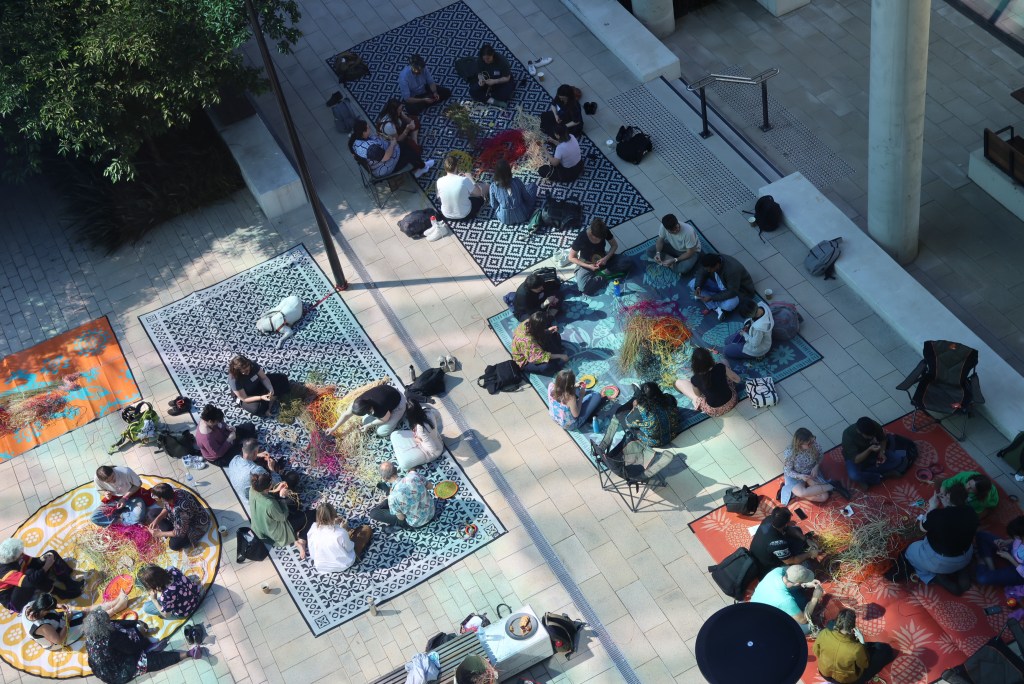
Second, we organised a weaving workshop for participants to reflect on embedded values and processes of knowledge making. We were fortunate that senior Ngaanyatjarra lore women Dr Elizabeth Marrkilyi Ellis and Aunty Nerida Giles were available to lead this activity while undertaking a Bandalang residency at ANU, assisted by Indigenous and non-Indigenous members of the Fenner Circle.
Third, Ngunawal elder Uncle Wally Bell led a series of cultural tours of the ANU campus. These tours offered a different perspective on STS field trips, which often spotlight Western scientific institutions, such as museums or laboratory spaces. These tours, together with his generous Rite of Passage at the conference opening, highlighted Indigenous ways of knowing that predate and continue to exist on ANU university campuses*.
Decolonising the everyday
AusSTS 2024 would not have been a conference with realised decolonial aspirations without Indigenous peoples. Working with kate and Bri, we tried to craft and distribute the CFP (Call for Papers) to encourage Indigenous contributors; ensured conference dates aligned with mob events in Canberra; allocated sponsorship funds to pay Indigenous service providers; and offered free attendance for Indigenous scholars.
kate and Bri reminded us that we also needed to consider how non-Indigenous participants might respond to the proposed decolonial activities. As Indigenous facilitators would face potential harm if encountering (another!) reluctant or hostile participant, we decided that attendees should explicitly opt-in to decolonial activities, which many did—but not all. In opting out, some attendees remarked they had “done weaving before”, suggesting we could have been clearer about the important relational elements of this knowledge practice. Notably, no similar comment was heard of more ‘traditional’ academic formats.
There were further tensions to navigate. New decolonial conference activities brought new conference costs, placing pressure on the budget and raising questions about the politics around valuing Indigenous cultural knowledges through financialised (Western) value systems—and how these flow through to conference ticketing pricing while maintaining accessibility to early career researchers. These politics were not always understood and at times, some insistence was needed to pre-empt bureaucratic burdens often encountered by small Indigenous providers. We also noticed some tensions within ourselves, including a certain colonial tendency towards hasty problem-solving over the patience and care of yindyamarra called for by kate.
Continuing the journey
It is difficult to judge our success or otherwise in these initial attempts decolonise this conference and STS more broadly. We received some positive feedback from some Indigenous participants and presenters on the activities and overall approach. However, other feedback was mixed, with some worried that standalone decolonial activities risked perpetuating a binary between decolonising and more ‘legitimate’ STS knowledge activities. We agree this was a fine line to walk and there will be many alternative approaches.
We emphasise here that decolonising is a journey, rather than a one-off theme or set of activities. With this idea in mind, our main recommendation is that AusSTS continues to allow time and space for reflexive engagement to embed values of decolonising within our network through conferences and other knowledge-making practices. This must involve centring First Nations leadership from the outset—a process that should begin well before conference organising and be recognised as part of a broader, ongoing commitment within the field. We note there are already strong efforts within the STS community, such as the work of Top-End STS, to further this goal.
Decolonising your conference
Decolonising spaces and events asks settlers for a continued commitment to decoloniality as a guiding principle, especially when navigating competing demands where settler colonial values (such as speediness, efficiency, individualism, notoriety, traditional western scientific rigour and methods) are seen as neutral, normal, and even aspirational. Instead, settler events makers must understand that the work of decolonising—which happens in the everyday—means getting to know and accepting the limits and habits of colonial knowledge, and relationally building new ways of working and knowing together. These ways of working together must centre and resource Indigenous instruction, expertise, concerns, priorities and methods.
*
While applying this overview to your early plans to decolonise a conference or event, here are some other ways you can also engage with decolonising scholarly events:
- Attend Indigenous-directed and curated conferences, exhibitions, and workshops. Places to start include:
Indigenous Futures Unbound (November 4, 2025)
Keep an eye out for the 2026 AIATSIS conference
Check out the local NAIDOC event calendar, which often features events year-round.
- As a person new to decolonising spaces, consider what you may have to offer as skills or resources, to be applied and called on by Indigenous peoples with greater, and culturally situated expertise in decolonising. Consider how you might conduct yourself and your expertise if you are also in a context that you know little about.
- Check out our decoloyarn reflecting on hosting an Indigenous-led launch and notice the outcomes we measured the efficacy of the event against.
* ANU has campuses on unceded Yuin, Larrakia and Ngunnawal Country.
Image credit: Photo by Daniela Tan.
Citation: Cain, A. Temby, H. Liu, J. and Campbell, M. (2025, August 11), How to (start to) decolonise a science studies conference: reflections on AusSTS 2024, in, Decoloyarns, <URL>

 Decoloyarns