What does a decolonising event or celebration look like in an academic world? What does it feel like? There are many answers to this question, but here is one of ours.
In 2024, a group of researchers from the circle published a paper telling the story of the positive and curious effects that flow from learning within an Indigenous-led space located in the settler-state academy. The paper describes how different initiatives run by the circle form yulang – ripples – including changing how researchers conduct themselves every day. These yulang also inform how we purposely and meaningfully disturb and navigate power in the academy as we seek to decolonize the academy in line with Traditional Custodians’ wishes. This decoloyarn reports another yulang spreading from the activities of the Fenner Decolonising Research and Teaching Circle (the circle).
***
The launch
In November 2024, the Decoloyarns editorial circle held a live launch of this website, coordinated by Nyssa Miller and kate harriden, with the support of Gamilaraay woman Stacy Swanton and non-Indigenous conspirators Leila Noble, and Rosanna Stevens.
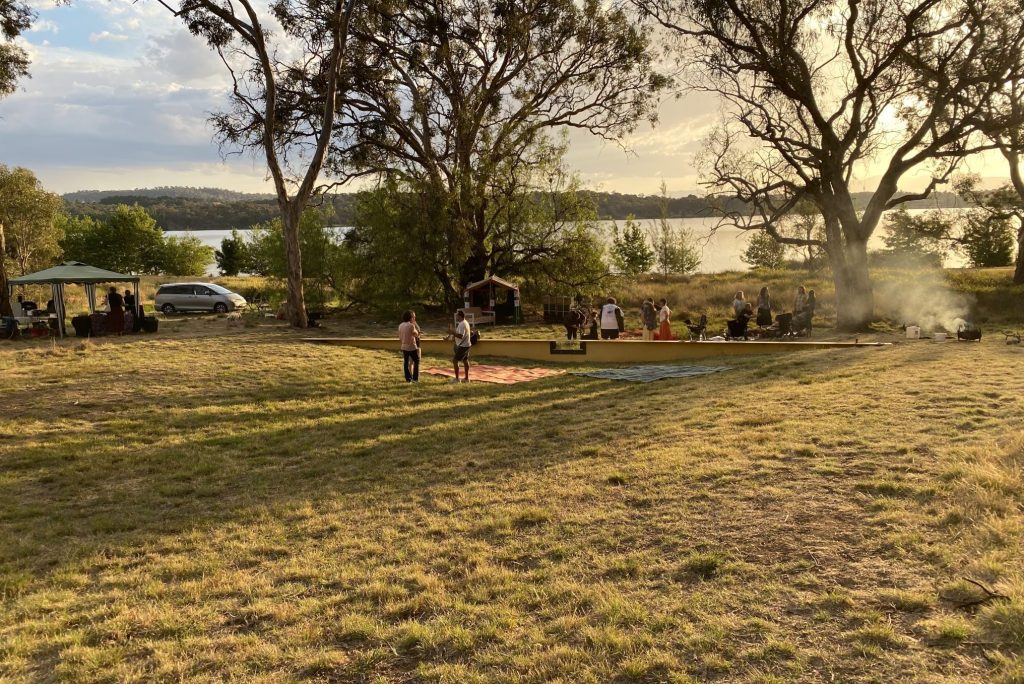
Forty First Nations and non-Indigenous community leaders, creatives, researchers and friends gathered outside on a warm evening on Ngunawal Country to celebrate the achievements of Bandalang Studio residents and fellows and the launch of a dedicated Decoloyarns website.
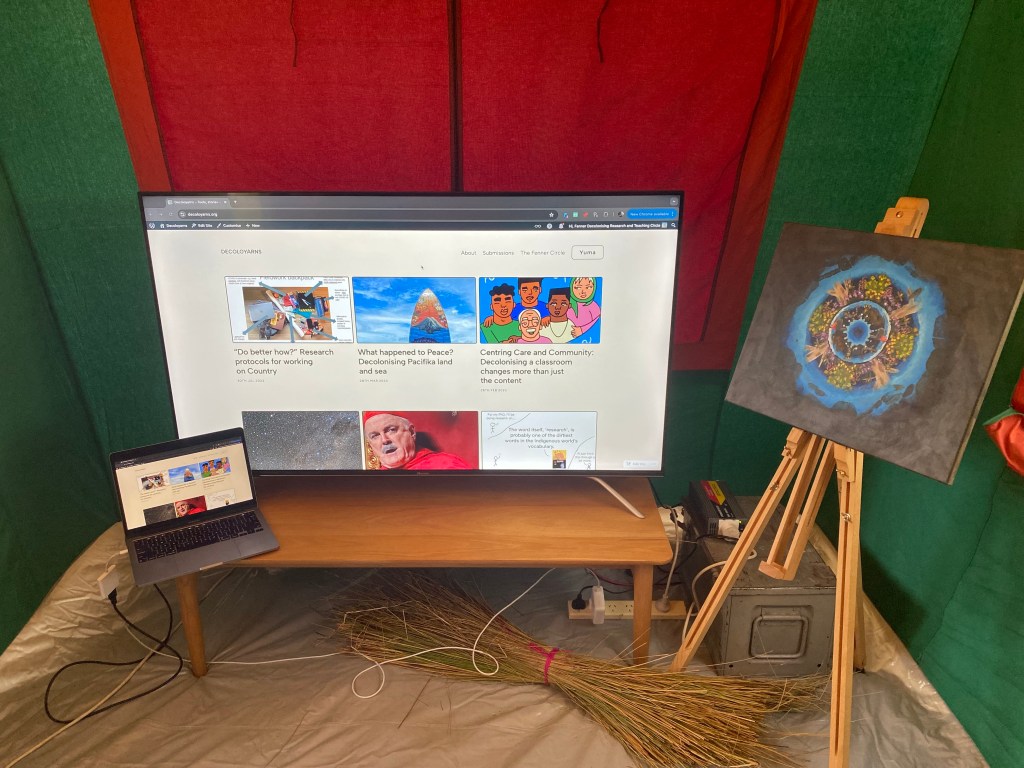
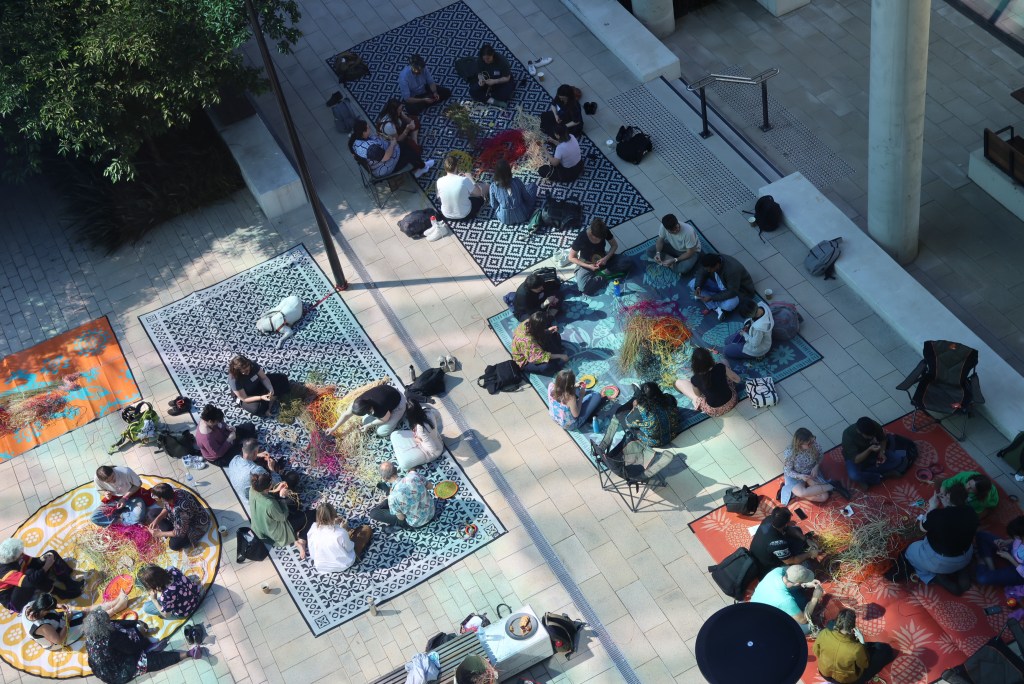
The launch had a camp feel, with mats on the grass for weaving and lounging surrounded by camp chairs. Tunes boomed from a bike-based sound system, lights were strung from the nearby trees, and a gumtree gave company to a gazebo shading Kaylene and Jodie, the two deadly chefs from McLeod’s Angels, who cheerfully and busily ensured all had a hearty feed. A green canvas tent with a sofa on the porch, housed an artwork by wiradyuri soil scholar Bri Gordon representing the Fenner circle and the interactive display of the Decoloyarns site.
Ngunawal Elder Uncle Wally Bell welcomed everyone to the launch by talking to Ancestors, asking them to keep us all safe on Country, conditional on our respect for Country. Acting Decoloyarns editorial convenor Rosanna Stevens (Rosie) talked about the both the purpose of the site and its story. The site’s development offered many lessons in yindyamarra (wiradyuri for being honourable, polite, going slow).
Rosie shared the story of our first independently published piece, Protocols for Working on Country. This article is a walang – a rock – in its own right. Firstly, the protocols provided the catalyst to move from a set of hosted articles on the Fenner School for Environment and Society website, to a fully-fledged independent and self-determined space. More importantly, the protocols have been downloaded 130 times since the protocols went live in August 2024, rippling the work of authors Renée Hartley, Kate Bellchambers and Traditional Custodians back to people and Country – from where it came – to form better relationships and stronger research practices with Country.
Uncle Wally noted that the document stands as a potentially useful tool for local, state and federal government and policy workers engaging with Country and Traditional Custodians. In 2025, our plan is to create ways to better proliferate work such as this, so it ends up across the desks of those who need it most. We invite you to be part of this way of proliferation.
We were privileged to gather with many authors whose work is on the site. The editorial circle also met potential authors who had pitched to us, and newer faces with valuable stories to share. You will see some of the outcomes of these connections on the site throughout the year.
The website
The purpose of Decoloyarns is to share stories and tools for the marathon of returning Country to First Peoples, in our various roles as researchers, leaders, participants, coordinators, interrupters, co-conspirators, and survivors. That is, Decoloyarns is a platform for First Peoples and settlers wanting to decolonize the academy. The yarns themselves demonstrate decolonial experiences, while providing those interested with important evidence of Indigenous-led thinking, to support incorporating decolonizing aims in their research or teaching practices.
The pieces on this site are offered as an alternative to First Peoples having to always be the ones to throw the walang into the bilabang of academia. To this end, the Fenner School for Environment and Society has integrated Decoloyarns onto their Indigenous scholarship page on the School’s website. This offers the School a strong, respectful connection to the site while honouring our autonomy; a yulang we welcome.
In the meantime,
We give thanks to the dedication, passion and drive of Ruth Mills, the inaugural Decoloyarns editorial convenor. Without Ruth; her curiosity, persistence, and honesty, there would be no beginning.
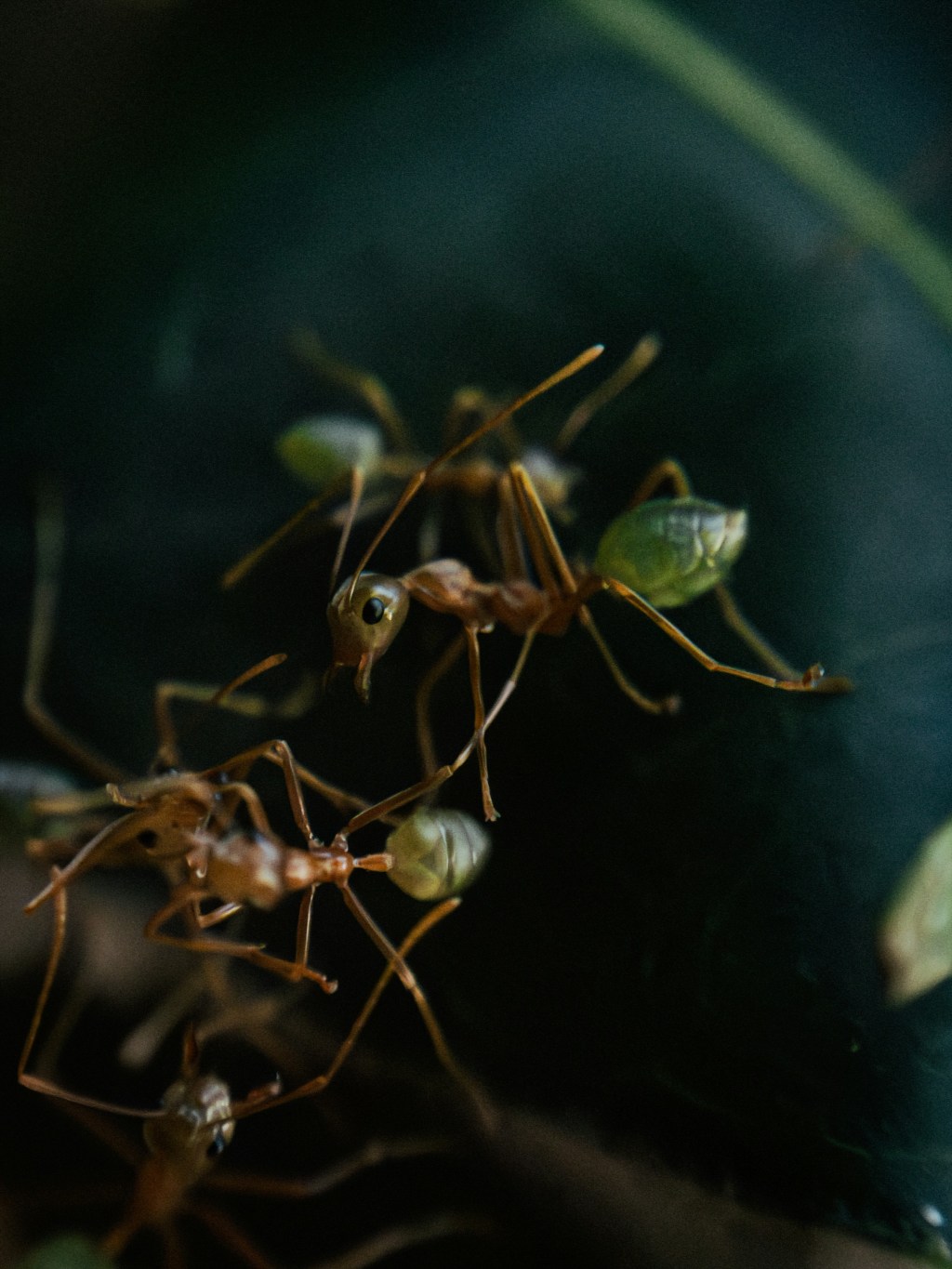
We remember the launch as warm Ngunawal evening air with Country watching us. We remember Aunts laughing, and Bandalang Studio occupant Shay Taylor and editorial circle member Sophia Dacy-Cole tending to all by setting up camp and handing out flowers from Ngunawal Country in thanks. We remember the ants walking along the plates and laps of people sitting on Christine O’Loughlin’s Spirit Levels sculpture, and containers of fresh melon and berries for everyone to take home. We remember the twilight that turned everything blue as we packed up camp. This is the yulang we live for: happiness and being together.
In future we are planning to connect up with similar groups across the University, and provide workshops to help potential authors get a sense of the kinds of pieces we’re keen to nurture, and how Decoloyarns like to work according to protocols of respect. For now, you can read more about these processes here: we are open for pitches.
Thanks to the Bandalang Studio for supporting much of the coordination of the launch. And a huge thanks to the Student Extra-curricular Enrichment Fund [SEEF] for supporting this launch.

 Decoloyarns
One response to “Yulang: Reflections and ripples from a Decoloyarns party”
[…] out our decoloyarn reflecting on hosting an Indigenous-led launch and notice the outcomes we measured the efficacy of the event […]
LikeLike